
A few days ago, I got a phone call asking if I was looking for a remote job as a translator. Like any good, legitimate freelancer who puts her resumé out there, I said yes. The recruiter gave me some sample work to do before they added me to their translator pool. It was just your everyday shopping mall localization stuff; nothing too out of the ordinary. But then the red flags started a-waving : the so-called “editor” started making weird spelling mistakes that no self-respecting editor would make. Then, they sent me a link to a website and told me to sign up (with my personal information, down to my phone number and zip code). Next, they told me I had to pay upfront for ‘royalty fees’ before I could withdraw the compensation for my sample translations! At this point, the alarm bells were screaming code red in my head. I alerted the authorities and blocked all contact. I had narrowly escaped the clutches of a job scam.

Now, I’m just one person, and I already have years of remote work experience that have honed my instinct for what’s normal and what’s not. But this is an alarming and growing trend. In the past five years, people have lost up to THREE. HUNDRED. PERCENT. more money to job scams than they did in 2020. And this is an underestimate, because fewer than 5% of victims actually report their losses. In 2024, 20,000 people reported specifically getting ripped off gamification scams. If we do the math, this means that at least 400,000 people fell prey to gamification job scams alone. And job scams are only rising exponentially ever since AI entered the picture, with their methods growing increasingly insidious. According to the FTC, the typical victim loses about $2000 USD to these scams, although the real numbers could be much higher.
And no one is safe from their clutches. Although people often assume that the older generation is more vulnerable to these scams, it now appears that young Gen-Z and Millenial men in particular are more than FIVE TO SIX TIMES more likely than Baby Boomers to fall victim to such scams.
Clearly, just being tech-savvy is not enough to protect you. So, how do we protect ourselves from these job scams in our search for remote work (or any work, at this point, for that matter)?
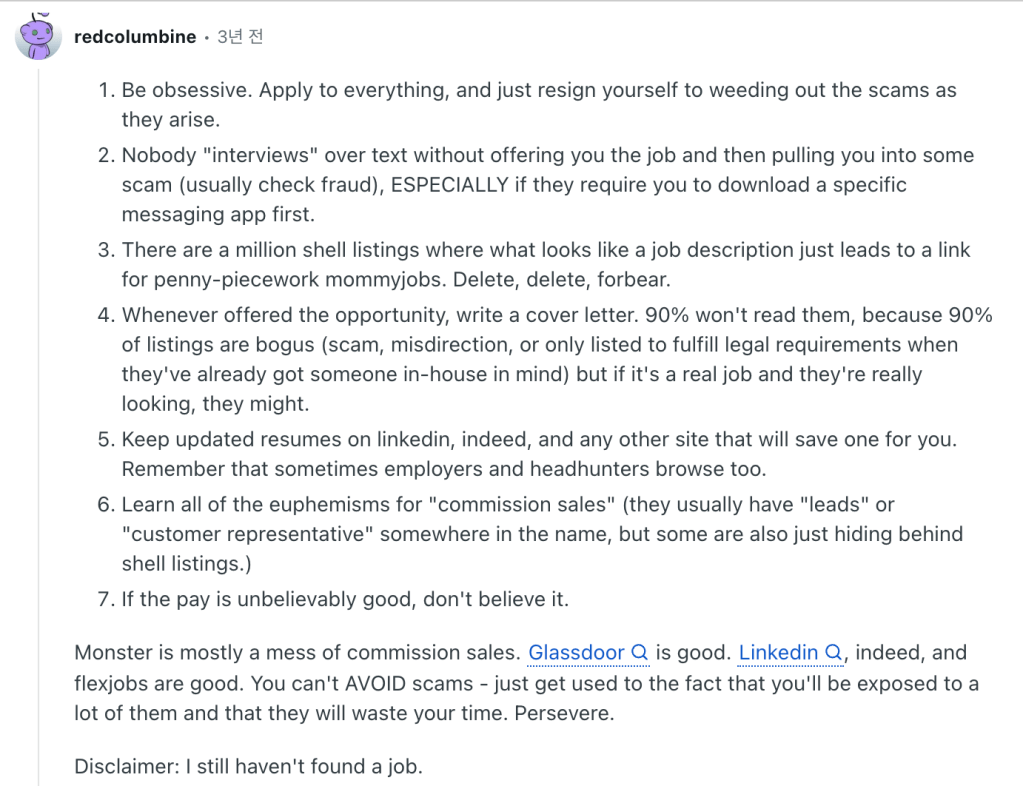
You can be vigilant without giving up your job search, just like this redditor!
How to avoid remote work scams in 2025

1. Make sure that the employer actually exists.
According to the Commerce Institute, up to 5 million new businesses are created every year. So, just because a prospective employer is new, this doesn’t mean that it is automatically untrustworthy. But there is always a way to verify whether or not an employer is legitimately registered with the country they are based in. Every country has an official business registry website.
Check which country a company is based in, and then go look them up on the official business registry. If they’re not registered, they’re about as real as the flying spaghetti monster.
2. Look very closely at email domains and links.
Many, many scam sites exploit slight typing variations or typo possibilities to trick people into visiting fraudulent websites, and the same applies to fake jobs. Triple-check the url of any website you are on and make sure you haven’t made a typo. Hover your mouse over any links that you are given so you can preview it in advance, if possible. Also, bear in mind that legitimate companies with legitimate website will generally use email domains that use their company’s name. Again, this is not a hard and fast rule, but trust your gut instinct and practice basic internet security.
3. Use official channels to apply.
Don’t send DM’s or messages on WhatsApp to unknown recruiters. If they try to onboard you through a separate, suspicious website’s chat function, it’s very unlikely that they are legitimate. Whenever possible, go through multiple official channels such as widely-known platforms (indeed, Linkedin etc.) and email providers (gmail, corporate mail, etc.).
4. Research their reputation.
Type ‘scam’ or ‘reviews’ and then the company’s name into a search provider like Google. For tech startups, there will usually be a few stars and reviews on sites like Reddit, Trustpilot, Indeed, or Glassdoor. My go-to search term is “Is [insert company name here] legit.” But even this can sometimes be manipulated, because some companies will purchase good reviews, so it’s not a failproof method.
5. Be realistic: if it’s too good to be true, it probably is.
No company is going to offer a monthly salary of $3000 + USD on a vague job description with ‘no experience required.’ Remember: if it’s too good to be true, it probably is. Research the reasonable price points and requirements for similar job postings in the field. If it deviates too much from the norm, stay away.
6. Never pay upfront.
Companies are supposed to pay you, not the other way around. If the recruiter asks you for an upfront payment that they promise to reimburse later somehow, turn and run in the other direction, and don’t look back, because it’s a scam. It’s the oldest trick in the book: the Nigerian Prince Email Scams, Indian Callcenter Cash back scams, and Catfishing Romance scams all operate on this same basic principle.
7. Guard your personal info until your offer is officially verified.
Do not provide bank account information, passwords, social security numbers, addresses, names of family members, or other private identifying information until you are confident that this is a legitimate offer.
8. Proactively ask for a voice call/ video meeting, or to communicate with other team members.
If you have one recruiter through which all communication takes place, and/ or if you feel that they are trying to isolate you in some way, ask to communicate with other team members, or directly with HR. Ask for a voice call or video meeting and check to see if the person seems to be who they say they are.
9. Cross-check on other sites such as Linkedin and use reverse image search.
If your recruiter has a profile photo or a legitimate name that you can verify, run them through Google or reverse image search, cross-check on other verified sites such as Linkedin, and make sure they provide at least two or different means of communication (e.g. a phone number AND an email address).
10. Contact the phone number on the official site directly.
Usually, url scammers will copy and paste websites and tweak them a little to look slightly different. For example, a company that wants to pretend that they are “Nike” could make a website with “niike” somewhere in the url. It’s the same crude logic underlying the black market of cheap luxury goods copies. If you suspect that this is the case, search up the official website of the company that is being impersonated (Nike, in our example) and contact the phone number on their website directly. Usually the impersonated company will also be able to file a complaint against the scammers, so make sure you give them screenshots and tell them what happened. They may or may not reach out to you for a witness statement later on.
11. Check payment practices and avoid check-deposit equipment reimbursements, crypto, or gift cards.
Any company that says they pay with crypto or gift cards without being explicitly prompted to do so is not trustworthy. Avoid at all costs.
12. Avoid relying solely on Telegram, WhatsApp, or social media.
Most online scammers use popular social media accounts such as Instagram, TikTok, or Twitter to approach potential victims in some form. Messenger apps such as Telegram and WhatsApp are also prime targets for scammers. While some legitimate companies might use them later on, it’s rare but not heard of for recruiters to cold call random recruits through such apps in the onboarding process. If your prospective employer insists on maintaining contact only through messenger apps, ask them to move to another platform or to contact you through their corporate email .
13. Resist pressure tactics like “urgent — respond in one hour.”
If the person on the other end of the line keeps rushing you or making increasingly impossible demands on you, it’s likely that they aren’t familiar with the normal pace of their field, and they’re also trying to rush you into making a decision before you spot something suspicious.
14. Protect your device.
Avoid downloading remote-access tools, unvetted files, or “test tasks.” If they ask you to do large unpaid work at the first hello, cut off contact, even if they promise later compensation.
15. Keep records of everything, just in case.
Save screenshots and email headers so that you can report suspicious roles to the job platform and/or authorities in your location.
Human-powered Guarantee (or disclaimer, depending on who you ask!) : I don’t believe in outsourcing my own intelligence to Artificial Intelligence. Unless specifically otherwise noted, all my work is typed using my own ten fingers to compile what my eyes see on my physical screen.
© 2025, YK. Jung, a.k.a. the Human Cookie Dough Wrangler.

If you found this article helpful, please consider grabbing me a coffee over at https://buymeacoffee.com/cookiedoughonline
 Cookie dough. online
Leave a comment