
My first brush with the concept of LLMs (Large Language Models) was way back before Chat GPT, in 2013, in my early young adult life on a college campus. Apparently, the novelty chatbot A. L. I. C. E (Artificial Linguistic Internet Computer Entity) had already been around since 1995, but that was all it seemed to be at the time: a novelty, a fun idea, more like a stunt that the Wachowski brothers might pull on college kids, or a hoity-toity conceptual art project dreamt up by someone too enamored with Wittgenstein. iPods were still a thing. The first smartphones were just starting to hit the market. This was not even 12 years ago.
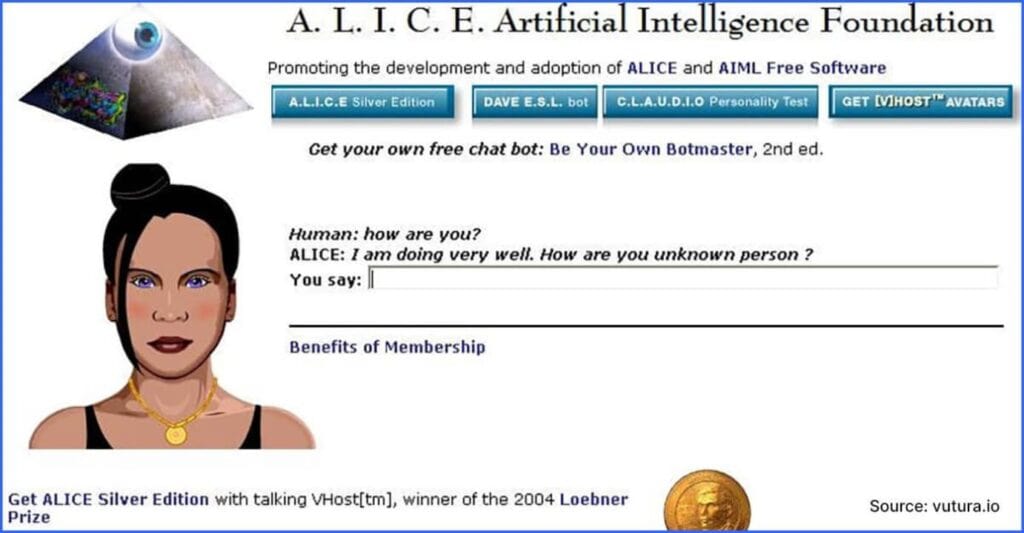
Source: vutura.io via the Computer History Museum.
In the space of a little over a decade, there have been…… changes. Changes that, back then, would have been considered science fiction, at best. Changes that, at worst, could have had you carted off to the mental ward for the disturbing dystopian nightmares that ensued. For better or worse, that’s where we are right now: a critical juncture.
It’s already happening — the big AI job reset. As I wrote at the top of a previous blog post, nearly half of all jobs will be directly impacted in some way by AI, and 9% of all existing professional job sectors will simply disappear in their entirety. But Open AI states that these figures could actually be much higher: 80% of workers could see their jobs impacted by AI. In the coming years, people are going to lose their jobs in the hundreds of millions.
Did I mention that this is already happening? No sector is immune, not even — especially not — tech, as evidenced by the recent layoffs of THOUSANDS of workers at Google, X, Amazon, Meta and more. You already know this if you haven’t been living under a rock or letting the rosy glasses of corporate jargon blind you to what’s really going on. And bear in mind that the full AI rollout really only began in 2022! In the space of the past three years, I have personally already lost many long-term clients in my multiple lines of commission work for translation, localization, and even education. Thank goodness for income diversification strategies, but they won’t stave off the inevitable for long.
For those of us who live by our wits, staying afloat while preserving some degree of autonomy is a constant act of maintaining a delicate balance. How do we navigate the brewing storm without going under or losing our bearings? We need to know which dead-end traps to avoid, first and foremost, right?

It’s like living through a real-life version of one of those Aivazovsky paintings or something! How poetic…… Source: https://www.sothebys.com/en/buy/auction/2019/russian-pictures/ivan-konstantinovich-aivazovsky-ship-at-sunset-off
So, here I’ve compiled a list of 10 jobs that will be replaced by AI before 2030. I don’t normally issue sweeping declarative blanket generalizations like this. But, barring unforeseen circumstances such as a complete global energy grid blackout, I can say with almost 90% certainty that these jobs are much more likely than not to be largely replaced by AI by 2030. In fact, they are already being massively impacted, if not already on their way out, as of this writing in 2025. Check back in a few years to see how I did.
8 JOBS THAT WILL BE REPLACED BY AI BEFORE 2030
1.Customer service call center agent / Telemarketer / Outbound sales via script

image by Mikhail Nilov on pexels.com
According to Goodcall, AI may not immediately “eliminate the need for human interaction in more complex or emotionally nuanced situations.” However, chatbots and virtual assistants have swiftly taken over the most simple and repetitive tasks. These automation tools are taking on increasingly specialized roles that were previously handled by human agents. This trend is only set to increase in the coming years. Although the annual industry turnover rate is already high at 30-45%, broader industry layoff data shows that there have been mass layoffs in the hundreds of thousands at over 3555 companies as a direct result of automation, and there will be more to come.
2.Translator / Interpreter

image by Berna T. on pexels.com
Over the past three years, the accuracy of translation algorithms has shot up by a staggering percentage, as Google translate now supports over 130 languages with accuracy ratings between 55% to 94%.
My multilingual cohort of fellow translators and I have borne the full brunt of this first wave assault. The stats back up what we’ve been directly experiencing: last year, the Society of Authors revealed the mortifying statistics that over a third of translators (36%) had already lost work due to generative AI, and over 77% of translators believed that generative AI will negatively impact future income from their creative work.
I thought that my simultaneous interpretation work would be safe for at least a few more years, but I’ll admit that the sudden sharp rise of relatively accurate automated dubbing and voiceover technology has shaken me to my core. Unfortunately, our work is being even more devalued than it already was, and this wasn’t a standardized industry to begin with.
Real translation and interpretation work requires years and years of rigorous training, exposure, and discipline over the span of a professional’s lifetime. But rather than pay to hire a professional, many companies are increasingly opting for cheaper, seemingly ‘good enough’ options that Chat GPT, DeepSeek, Google Translate, or Deepl can provide. And even the more creative or human-led areas of translation and interpretation aren’t safe, as the next job group on the list will show.
3. Content writer, non-investigative journalist, scriptwriter, proofreader, editor, illustrator, musician, or any entry-level jobs for creative workers in general

image by Juliane Monari on pexels.com
Automated correction technology for grammar and spellcheck, such as Grammarly, has been around for decades (much to the chagrin of my fellow teachers, who have been firsthand real-time witnesses to the death of literacy in schools). As professional tools, these can certainly be useful to a degree. But surely, these simple tools could never eliminate the need for intelligent human feedback?
Unfortunately, and shockingly, this no longer seems to be the general consensus in the professional world. According to the above-quoted 2024 survey from the Society of Authors, an increasing number of publishers and commissioning organizations are reportedly requiring their creative workers to use generative AI such as Chat GPT in their paid work. Not only is this an insult to the integrity of the creative worker in question, it would have been a breach of professional conduct and an embarrassment to any self-respecting organization even as recently as five years ago.
Ever since the Writers’ Guild of America strike in 2023 first brought awareness to the issue of tens of thousands of AI-related layoffs in the creative sector that directly threatened the livelihoods of actors and scriptwriters as well as the very existence of the creative industries, AI adoption has only grown to spread across even more industries. Now, publicly available AI tools provide not only the ability to generate inoffensive milquetoast texts devoid of writers’ personal idiosyncracies, but also disturbingly uncanny videos and images — and even AI-generated music! — on a mass scale.
One interesting 2025 study on these strikes notes that many creative workers “anticipated AI leading to automation and disruption, they foresaw AI contributing to the trivialization and invisibilization of their labor, holding the potential to deplete the expression of human complexity that is core to their craft,” while also viewing AI with concern as being “potentially exciting and useful but also unimaginative and anxiety-provoking for film production because of several qualities (e.g., its regurgitative capacity, reductiveness, artificiality),” and acknowledging that “under fair working conditions, alternative futures of AI filmmaking may be possible, while lowering barriers to entry for independent filmmakers.” Unfortunately, the conditions for those happy “alternative futures” do not seem to describe the world we’re living in right now.
4. Any jobs in the medical, therapeutical, and legal fields that do not involve direct contact with patients and clients

image by RDNE Stock Project on pexels.com
As early as 2023, the OECD reported that AI is most likely to directly impact “highly skilled jobs in field such as medicine, law, and finance” :
“Occupations in finance, medicine and legal activities, which often require many years of education, and whose core functions rely on accumulated experience to reach decisions, may suddenly find themselves at risk of automation from AI.”
Although roles that involve direct human-to-human interaction — such as physical checkups, administering medication, and delivering in-person counseling — will probably survive, it is feared that most of the middle tasks and even professional roles that require expertise will largely be eliminated if AI continues to grow at the rate that it currently does. And even if they survive, many of the jobs we know today may simply be unrecognizable within the decade : professionals with knowledge, expertise, and valuable experience may soon largely be replaced by machine-minders that rely on automated code to assemble relevant data from datasets to deliver clinical verdicts. Even in-person counseling may be at risk: more people, particularly members of Gen Z, are turning to ChatGPT for affordable and on-demand erstwhile therapy, which is very dangerous but becoming more and more widespread.

Source: David Wolfe facebook
My research (as well as my gut instinct that directly stems from being a human being with critical reasoning capacities and lived experience) tells me that this is a highly dangerous development if not handled delicately and properly on a governmental and social level. Doctors studying human anatomy, lawyers studying legal processes, and professional psychiatrists, psychologists, and therapists who know the ins and outs of the human mind are not just a bundle of facts and metadata. It seems that the AI technology has managed to wedge itself into the gap between the latent imposter syndrome of higher-educated intelligent individuals and the general public’s ignorance on what it takes for experts to carry out incredibly complex tasks. This particular forecast is not just depressing, but also incredibly alarming.
5. Financial sector jobs such as bank clerk/ new-accounts clerk/ basic financial clerical roles

image by Tima Miroshnichenko on pexels.com
PwC, a Big Four firm in the UK, estimated in 2018 that up to 30% of current jobs could be automated by the ‘third wave’ of automation around the 2030’s. Oxford Economics group predicted that 20 million manufacturing jobs would be lost by 2030, with 60-80% of jobs being expected to be automated or transformed by 2050. The World Economic Forum has also noted that, in the 2025-2030 time period, two fifths, or almost 40%, of workers’ existing skill sets will become outdated. Jobs in the financial sector are going to be among the hardest hit, with AI adoption soaring in fintech already . Three quarters, or 75%, of financial organizations are already now using AI. This aligns with the statistic that up to 70% of jobs in banking and finance have already effectively been replaced by AI. With the financial sector’s dependence on AI growing stronger, and talk of the possibility of a global AI bubble crash looming ever larger on the horizon, the replacement of financial sector jobs through AI automation just might be the least of their worries.
6.Administrative and clerical work such as data entry clerk / Routine clerical work/ Retail/ Ticket agent/ Receptionist/ Front-desk roles with standardized tasks

image by Cottonbro studio on pexels.com
In 2025, 65% of cashier and checkout jobs faced automation, and data entry and administrative support was at 95% risk of automation. By 2027, we’re already looking at the elimination of 7.5 million data entry and administrative jobs. With the expansion of automated routine processes such as self-checkout and AI verification, tens of thousands of cashier jobs in the United States alone may simply disappear (a 10% decrease, to be exact: the USA is headed towards a 313,600 projected job losses specifically for cashiers alone between 2024 and 2034, according to the US Bureau of Labor Statistics).
In the process of my research, I couldn’t help but be stunned by the absurdly cheerful logic of AI automation being a ‘good thing’ despite forcibly furloughing entire generations and demographics from the labor force because it ‘creates more profit’ and is more ‘efficient.’ It’s like plowing through the entire job market with industrial bulldozers. And no one knows what will come next, other than the vague sunny promise of ‘jobs we couldn’t have even imagined.’ I, for one, don’t exactly buy it.
7.Middle-management or analyst positions with summarization, report generation, or routine decision support roles

image by Yan Krukau on pexels.com
Dire forecasts over AI spelling an end to entry-level jobs have certainly been corroborated by the statistics, with entry-level job postings in the U.S. overall declining about 35% since January 2023 largely as a result of the widespread implementation of AI. However, by the exact same mechanism, middle-management levels are not safe from the purge either. Because AI is naturally much more productive and efficient at producing the rote regurgitation and summarization that many mid-level and managerial office reports require, companies with more reductionist productivity markers may use this as an excuse to lay off staff at all levels, effectively signaling the death of equity and social mobility in business as we knew it. Bloomberg reports that AI could replace 53% of market research analyst tasks and 67% of sales representative tasks, and, according to analysts like Chris Hood, companies can and will cut entire layers of management.
The dangers of slashing entry-level jobs just for the sake of cutting costs are evident, as the Harvard Business Review has pointed out: the job market will completely collapse, and new jobs will not be generated at a speed quick enough to keep up with the devastation.
8. Any tech jobs that don’t directly handle AI or hardware

image by Christina Morillo on pexels.com
And finally, it seems that the so-called AI revolution is starting off by eating its own children in the tech sector, with at least 150,000 job cuts in the 2024 tech layoff wave that swept across 549 companies in 1,115 mass layoffs that impacted 238,461 people in total. This layout tide doesn’t seem to be ebbing anytime soon: so far in 2025 as of this writing, there have been 579 mass layoffs with 161,859 people impacted. That’s a rate of 541 a day. And the ticker keeps ticking.
˖
⊹ ࣪ ﹏𓊝﹏𓂁﹏⊹ ࣪ ˖
˖
Unfortunately, the list of jobs that will be replaced by AI does not end here. Barring unforeseen circumstances, AI will basically impact, and largely replace, all knowledge work that focuses on writing or summarizing tasks that are communication-heavy but pattern-based. That description applies to most, if not all, entry-level clerical, administrative, academic, and knowledge-work positions. Honestly? These are absolutely impossible odds for survival when it comes to college graduates, freelancers, or really just about anyone who needs to make a living on an independent income and isn’t protected by seniority, a trust fund, or a 401k.
It’s difficult to imagine who’s going to be left standing, and how, when this storm blows over. COVID was bad enough, with the economy tanking and everyone forced to go online. But now that we’ve figured out how to start rebuilding our lives online, we’re now faced with a changing virtual landscape of AI-spurred job losses and automation and scams on the one hand, and wars and sociopolitical instability on the other.
In a moment of weakness, I caved and asked Chat GPT how it thinks I should prepare for this impending tectonic shift in the job market. This was its response:
Not all tasks in a role get replaced but roles with high proportion of automatable tasks are at greater risk. Many sources emphasise “exposure” rather than full replacement.
Being in a “low risk job” doesn’t mean no change — roles may evolve, new tools may shift how you work rather than eliminate you entirely.
Upskilling, specialising, focusing on the human-elements of your job (judgement, creativity, empathy, managing unpredictability) increases resilience.
Sure, I mutter back at the horribly placid LLM chatbot spouting regurgitated half-truths and unfeasible solutions. Easy for you to say.
In the next few posts, my distraught human brain and my frazzled fingers and I will be typing out listicles of jobs that are least likely to be replaced by AI (in the best case scenarios), new jobs that might be created by AI, and ways to ‘future-proof’ your career in an increasingly turbulent future. I’ll also be churning out a few analyses about why all this is happening, and where all this is going, in my humble but honest personal opinion. Stay tuned, and stay safe out there.
˖
⊹ ࣪ ﹏𓊝﹏𓂁﹏⊹ ࣪ ˖
˖
Are you a writer, translator, interpreter, or freelance worker in a relevant field that has been affected by the recent deployment of artificial intelligence? Contact me with your story at yeinnaya@gmail.com
˖
⊹ ࣪ ﹏𓊝﹏𓂁﹏⊹ ࣪ ˖
˖
Human-powered Guarantee (or disclaimer, depending on who you ask!) : I don’t believe in outsourcing my own intelligence to Artificial Intelligence. Unless specifically otherwise noted, all my work is typed using my own ten fingers to compile what my eyes see on my physical screen.
© 2025, YK Jung, a.k.a. the Human Cookie Dough Wrangler.

If you found this article helpful, please consider grabbing me a coffee over at https://buymeacoffee.com/cookiedoughonline

 Cookie dough. online
Leave a comment